
Research on the Cytoskeleton
Interview with PhD Student Cedric Böger about his Award-Winning ALS Research
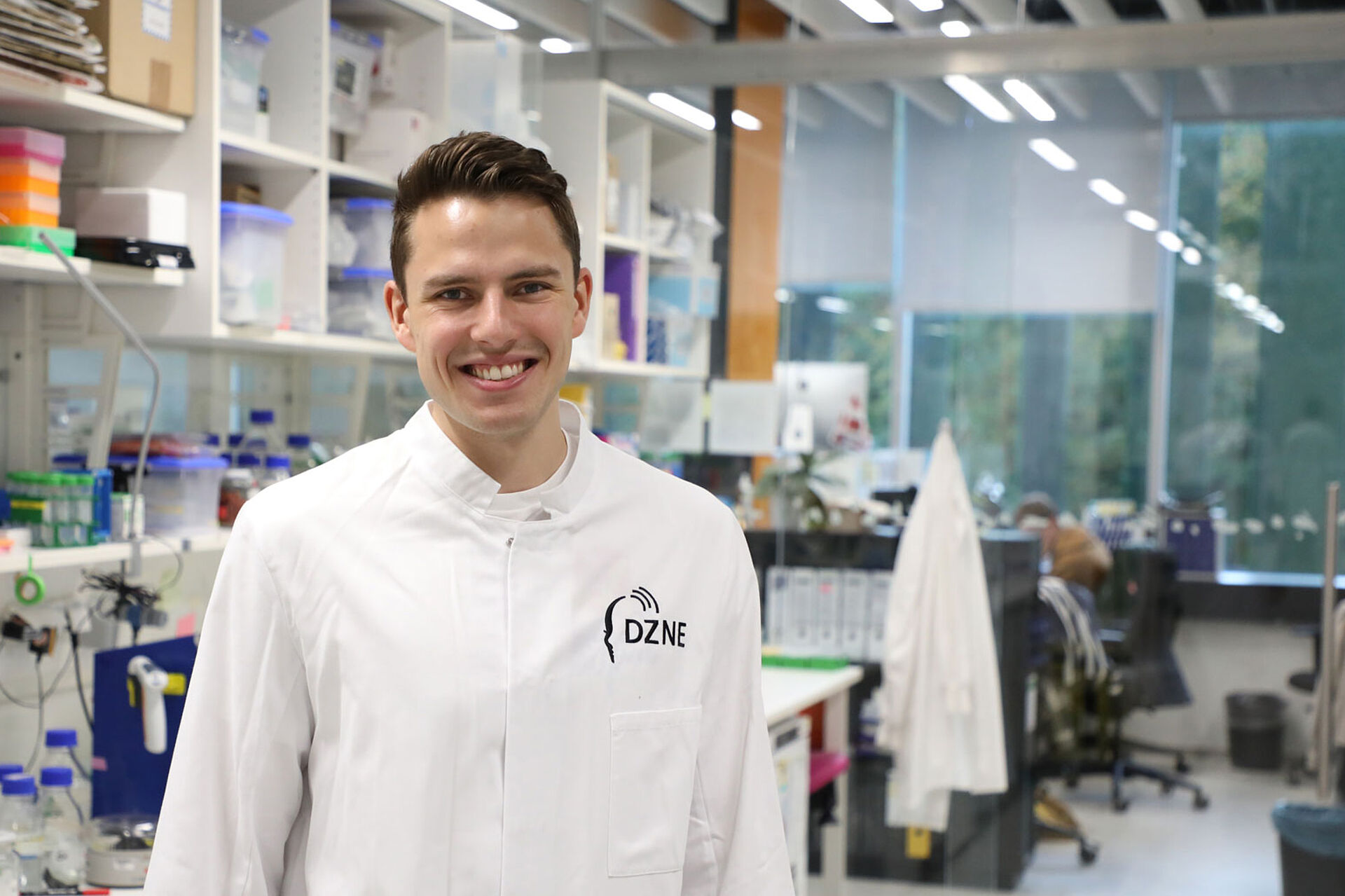
Bonn, October 23, 2025. Cedric Böger, PhD student in the research group of Prof. Frank Bradke at DZNE Bonn, was recently honored with the „3rd annual Drs. Ayeez and Shelena Lalji & Family Student Scholar Award for Repair and Regenerative Mechanisms in ALS“, worth 5,000 US Dollars. The award, presented for the third time since 2023 by the Healey & AMG Center for ALS at Massachussetts General Hospital in Boston and supported by Drs. Ayeez and Shelena Lalji as well as the family foundation „ALS Heroes“ recognizes Böger’s research on nerve cell regeneration in amyotrophic lateralsclerosis (ALS). In this interview, the neurobiologist talks about the personal significance of the award and how his work could open up new therapeutic approaches against the disease in the long term. Cedric Böger also reports on his impressions of the 24th Annual NEALS Consortium Meeting in Florida, where he received the award and had the opportunity to exchange ideas with researchers from around the world.
Congratulations! What does this award mean to you personally and for your scientific career?
Thank you very much! This award means a great deal to me – both personally and scientifically. It is a great honor that my work has been recognized on an international level, especially by a foundation so dedicated to people living with amyotrophic lateral sclerosis, or ALS, for short. The award helps me push forward my research on nerve cell regeneration and opens doors to new collaborations with researchers worldwide.
Your award-winning project focuses on axon regeneration—how nerve cells can regrow after injury. What exactly are you studying, and why is this important for ALS?
In ALS, certain nerve cells called motor neurons gradually die in the brain and spinal cord. These cells control our muscles. When they are damaged or their long extensions, the axons, die off, they usually lose their function. As a result, muscles can no longer be activated properly, leading to weakness and paralysis.
In my project, I investigate whether and how these motor neurons can be repaired. Specifically, I analyze how the internal structures of nerve cells—the so-called cytoskeleton—change after injury or in diseases like ALS. Normally, this cytoskeleton is stable, but during degeneration it breaks down, retracts, and accelerates axon loss. I study whether certain proteins can improve the stability of these structures and actively counteract these processes. If successful, damaged neurons might be able to rebuild their axons instead of degenerating further—a potential key to slowing ALS progression. Since the disease often advances rapidly and can lead to death within two to five years, improving this prognosis is of crucial importance.
How could your research approach change the understanding or treatment of ALS in the long term?
In the long run, I hope to better understand the mechanisms that determine whether a neuron can regenerate after injury. The cytoskeleton, despite being a core structure of neurons, is rarely addressed in current ALS therapy approaches. If we can learn how to activate the cells’ self-repair capacity and stabilize their internal structures, this could lead to entirely new treatment strategies—not only for ALS but also for other conditions involving nerve damage, such as spinal cord injuries. Of course, these broader questions are being investigated collaboratively within our entire research group.
You have been endowed with 5,000 US dollars in prize money to pursue new ideas – what will you focus on next?
The award money will enable me to test and refine new experimental approaches that would otherwise be difficult to realize. For example, I plan to use advanced microscopy techniques to observe live how the internal structures of neurons change in ALS cell models, in other words, to see in real time what happens in the neurons after injury and when they try to heal themselves. This will also allow us to monitor directly how our therapeutic approaches work. Such experiments could provide crucial clues as to which processes should be specifically supported.
You received the award at the Annual NEALS Consortium Meeting in Florida, which brings together ALS researchers from all over the world. What were your most exciting impressions or insights you gained from the conference?
I was invited to the NEALS conference for the award ceremony and had the opportunity to give a talk on my research findings. The conference was incredibly inspiring. It was impressive to see how many researchers around the world are working together to better understand ALS and develop new treatments. I was particularly fascinated by the discussions around ongoing clinical trials testing new therapeutic strategies directly in patients. There is a lot happening in this field of research right now. At the same time, I was impressed by the personal commitment of people living with ALS who actively contribute to research. These encounters show why our work is so important.
What are you gaining from the award and the meeting, and how will it shape your next research projects within DZNE and with international partners?
Above all, I gain motivation and new ideas. The meeting allowed me to establish many contacts with other research groups working on similar questions, especially in the U.S. Meetings like this keep us researchers up to date. It's very inspiring. In the future, we plan to strengthen these international connections to launch joint projects. Within DZNE, we will continue to focus on understanding the fundamental principles of nerve cell regeneration—with the aim of translating this knowledge into concrete therapeutic approaches.
Interview by Dr. Christine Knust
News by Sean M. Healey & AMG Center for ALS at Massachussetts General Hospital