
RAUM!Erleben - The importance of spatial orientation within the life-world: people living with dementia who live by themselves at home
Project overview
| Project duration: | 2022 - 2025 |
| Project funding: | Former Federal Ministry for Family Affairs, Senior Citizens, Women and Youth (BMFSFJ)
|
| Project lead and coordination: | Dr. Saskia Kuliga |
| Former project staff: | Dr. Daniela Templin Marie Wohlan (WissHK) Julius Manuel Strotmann (WissHK) Sebastian Dorfmüller (WissHK) |
| Commissioned work (Module 1.3) | Dr. Vincent Langenfeld Sânziana Maximeasa (Architektur) |

Background
There are approximately 1.8 million people living with dementia in Germany, some of whom live in single-person households. One goal of Germany’s National Dementia Strategy is to support people living with dementia and their relatives or care partners. Germany’s National Dementia Strategy focuses on research about the life-world of people living with dementia.
Spatial orientation is a key component of a person’s independence and social participation in everyday life: Disorientation can mean, among other things, that a person cannot (or no longer) independently orient or identify strategies to find their way within a space, e.g., in cities or buildings.
Especially for people with dementia who are living by themselves, it can sometimes feel like a burden to ask others to support them when they are navigating built space. People who feel self-confident and safe might be more likely to engage in activities in their neighbourhood, even in the absence of supportive others people; i.e., spatial orientation, social inclusion, and quality of life are connected.
Project aims
Funded by the former Federal Ministry for Family Affairs, Senior Citizens, Women and Youth, the research project “RAUM!Erleben” at the DZNE Site Witten focuses on the perspectives of people living with dementia and their lived experience of their lifeworld, in different living situations (e.g. living alone) and in different environments.
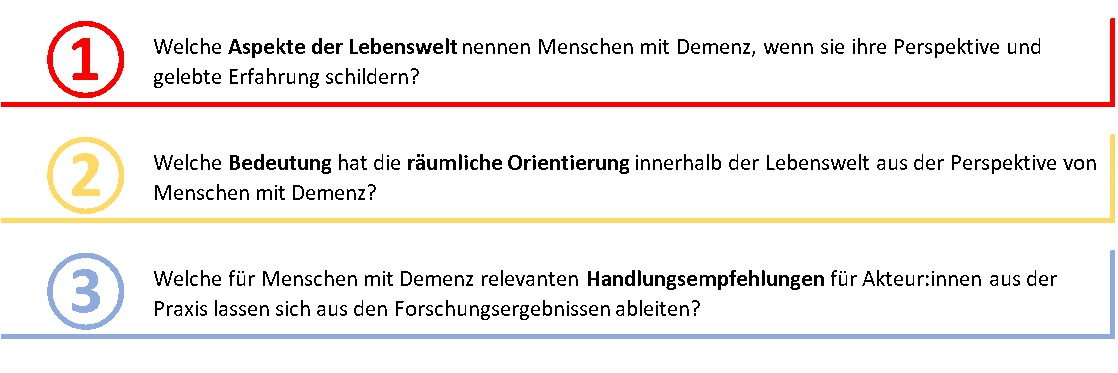
The aim of this research project is to investigate the significance of spatial orientation in the lifeworld from the perspective of people with dementia and to derive recommendations for action for practice from the research results.
Three research questions are central to this:
Methods
The research project relies on a qualitative, partially participatory research approach. Via walk-throughs, social/spatial analyses, and co-creative research methods, the project involves people living with early stages of dementia, volunteers engaged in services for people living with dementia, and practitioners. In particular, RAUM!Erleben seeks to shed light on the first-hand perspectives of people with dementia who are living by themselves at home (i.e., in a single-person household).
First results
The research results have been translated into recommendations for action for practitioners, such as local authorities and planning stakeholders, and have been made available to the specialist public. Three recommendations for action were central to this:
1) To promote more networking and exchange between people with early stages of dementia and young people with dementia in order to pass on and share lived experiences.
2) To further promote dementia-sensitive design of the public built and social environment; and, in particular spatial orientation at lived places, to foster social participation.
3) To strengthen appreciative communication at all levels and further strengthen society and points of contact in public spaces and with medical specialists.
The project also involved the participatory creation of various short films that tackle different perspectives of people with dementia who participated. A message, associated images and a schedule for the film were planned together, using interviews. The researcher then created the images and filmed them into a moving image. For reasons of anonymity, no identifiable data of participants is visible in the final version - their messages speak for themselves. The film are only available in German and can be viewed here. The films are protected under CC BY-NC-ND 4.0 and may only be cited with attribution: “research project RAUM!Erleben; funded by the former BMFSFJ, Saskia Kuliga/DZNE Witten, 2025”.
The RAUM!Erleben project contributes to further understanding the perspectives of people living with dementia with regard to their living environment and spatial orientation. In this way, the project can also provide impetus for so-called dementia-sensitive built environments and services, as well as ideas for a future national dementia strategy.