
From Postdoc at DZNE to Junior Professor
Interview with Scientist Dr. Dr. Jose Bernal on his Appointment at the FAU Erlangen-Nürnberg
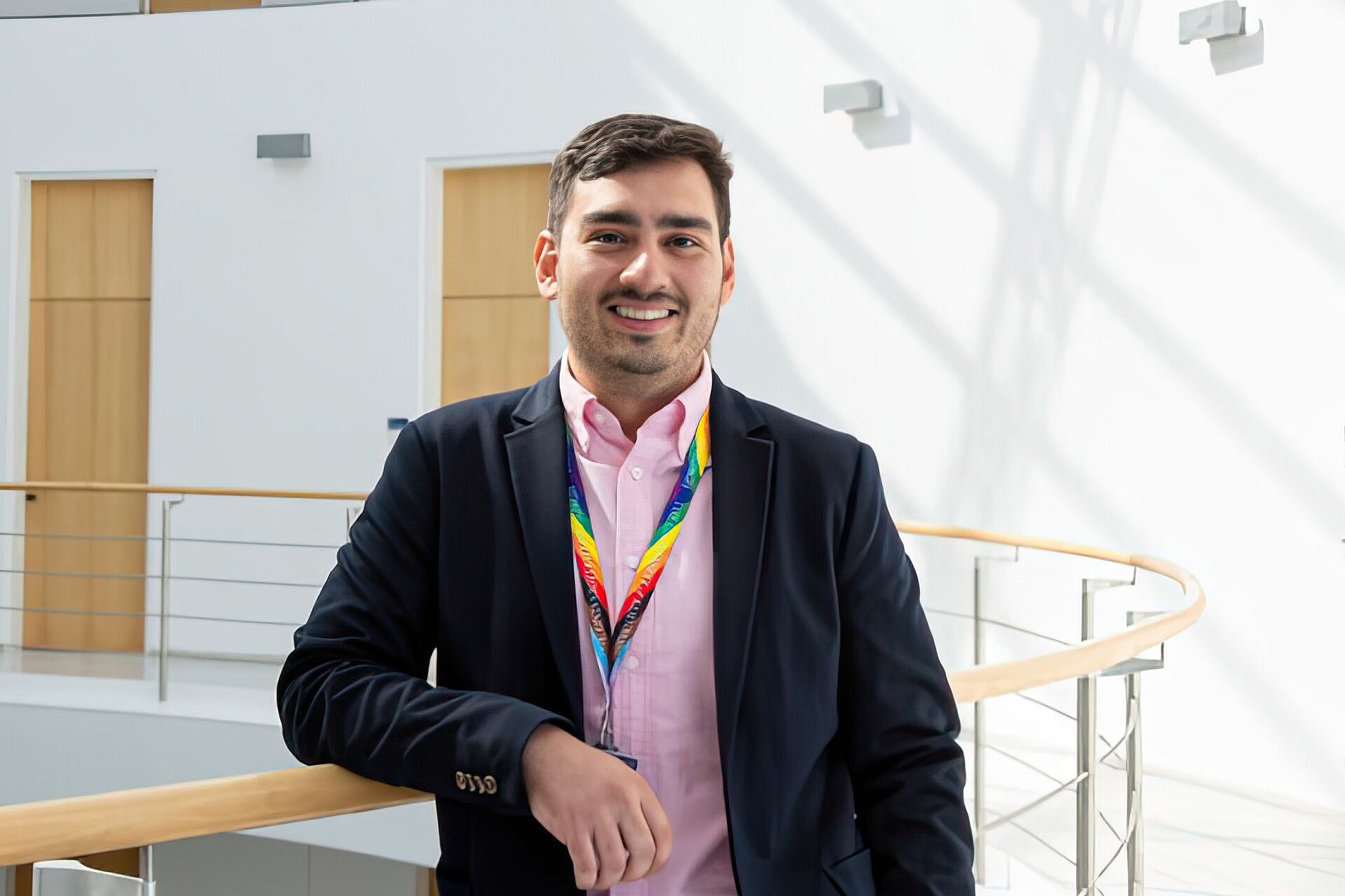
On September 1, 2025, Dr. Dr. Jose Bernal, until recently a postdoctoral researcher in Prof. Emrah Düzel’s research group at DZNE in Magdeburg, started as a Junior Professor for Artificial Intelligence in Biomedical Engineering (Digital Health) at the Friedrich-Alexander-Universität Erlangen-Nürnberg (FAU). In this interview, Bernal, who is originally from Colombia, talks about his path to becoming a junior professor, the particular challenges of the appointment process, his research into disorders of the smallest blood vessels in the brain using neuroimaging and advanced computational methods, and his plans for the future. The computer scientist also provides insights into the support he has received at DZNE and reveals which programs and networks he recommends to other early-career researchers.
You were appointed a junior professorship at FAU Erlangen. In the German academic system, “Juniorprofessor” is a specific career stage. Can you briefly explain how a researcher becomes a junior professor? What are the typical steps involved?
Within the German academic career framework, several routes can advance a researcher towards a full professorship, and becoming a junior professor is one of them. The journey usually begins with the completion of a PhD with distinctions and a strong publication record. Over the following two to four years, researchers develop an independent research profile in postdoctoral positions—securing grants, developing collaborations, teaching, and ideally gaining experience at another university or research center. When a W-1 Juniorprofessur is advertised, researchers can apply by submitting a dossier. A hiring committee reviews the submissions, invites shortlisted candidates for a research talk and teaching demonstration, seeks external referee reports, and forwards a ranked list to the senate of the university and state ministry, which issues the formal appointment. Appointments are usually as a temporary civil servant on a three-year contract, renewable once for another three years, with interim and final evaluations determining whether the position ends or, if designated as “tenure track”, advances to a permanent W-2 or W-3 professorship. Teaching duties remain moderate to allow research productivity, grant acquisition, and doctoral supervision to remain the primary focus. For anyone wishing to learn more about professorships and the application process in Germany, I can highly recommend Mirjam Müller’s book Bewerben auf Juniorprofessuren und Professuren.
What was your motivation to apply for the junior professorship?
I aspire to a full professorship—teaching at university and heading my own research group—and the junior professorship advanced me towards that aim.
Another motivator—for the wrong reasons evidently—was that I was rapidly approaching the legal limit for postdoctoral employment at DZNE under the Wissenschaftszeitvertragsgesetz (WissZVG). For context, the WissZeitVG is a German law that limits how long scientific staff below professor level can be employed on fixed-term contracts with public funding. I thus had to find an appropriate continuation before my time in the German academic system came to an end, so to speak, by force due to this law.
How did you prepare for the selection process – especially the sample lecture? What was the experience of giving the sample lecture like? Did it differ from your usual scientific presentations?
The selection process for junior professorships and professorships in Germany is both lengthy and demanding and requires substantial preparation. For the application, I had to compile a wide range of documents: the straightforward ones—such as a CV, lists of publications, third-party funding, and international collaborations—and others with which I had no prior experience and which therefore took the longest to prepare, such as the teaching and research concepts. I found two strategies particularly valuable in preparing both concepts. The first was to seek insights from others who had gone through the same process, as they knew first-hand how these documents should be structured and what content would be most compelling. The second was to draft an initial version, discuss it with friends, colleagues, and mentors to ensure it was credible and robust, and then incorporate their feedback into successive revisions. The interview had three parts: a 30-minute scientific presentation followed by a 15-minute discussion; a 10-minute teaching demonstration followed by a 5-minute discussion; and a 50-minute Q&A session with the hiring committee. The scientific presentation is, in some respects, the most straightforward, as it centres on familiar elements: the big picture of your own research, and work already completed, and the mutual exchange between what is brought to the new institution and what is gained from it—more or less what was already outlined in the research concept. The teaching demonstration differs from the initial scientific talk in that it is essentially a mock teaching session, delivering a lecture on a specific topic to an audience who, despite some being W3 professors, take on the role of students. It is typically more interactive than the scientific presentation, with the expectation to pose questions, show videos, and otherwise engage the audience as much as possible. It also serves as a practical demonstration of the approach described in the teaching concept. The final Q&A session is intense and, in my opinion, it is impossible to be fully prepared for it. Questions vary widely in nature and span a broad range of topics, including supervision, teaching, problem-solving, diversity and inclusion, funding, collaborations, and the overall vision and mission. To prepare as effectively as possible for the interview, and in addition to once again drawing on my support network, I worked with a coach who helped me understand what was expected at this stage. With their guidance, I was able to rehearse both the scientific presentation and the teaching demonstration, as well as take part in brief mock Q&A sessions.
What topics do you deal with in your work?
My research is highly interdisciplinary and revolves around cerebral small vessel disease, the name we give to problems that affect the tiniest blood vessels in the brain. They might be tiny, but these blood vessels keep brain cells alive and well—and when they cannot do they job properly, big problems, such as stroke and dementia, follow. I currently work along two research directions. I first work on developing advanced computational methods to detect and monitor lesions caused by cerebral small vessel disease in magnetic resonance images. I then apply them at scale to determine how these lesions emerge and progress over time, what factors contribute to their evolution, and how these lesions relate to ageing and dementia. With this work, I seek to create a better understanding of how the brain works—and what happens when it does not—to ultimately lay the groundwork for new treatments.
What will be the focus of your future research in your new role? Will you build on your previous and current work or will it be a shift toward new topics?
At DZNE, I studied lesions connected with cerebral small vessel disease, a rather common condition occurring in the ageing population, that affects the integrity of the brain’s microvasculature. I was generally able to show that, although we usually think of these lesions in relation to blood vessel problems, they also relate to other types of problems such as Alzheimer’s disease. This work contributes to the understanding of this complex disease and could inform new treatment options. I particularly studied two lesions or markers of cerebral small vessel disease, namely perivascular spaces and white matter hyperintensities. Perivascular spaces are normal physical compartments around small blood vessels in the brain. They are so small (microscopic) that, in principle, we should not see them on conventional magnetic resonance images. However, under certain conditions we do, and this unusual visibility has been a matter of research for many years, as it is believed that it might reveal early underlying pathological mechanisms. In a first-of-its-kind study, we found that people whose perivascular spaces became more visible over years had more signs that their brains accumulated “brain waste products”, particularly waste products that are related to Alzheimer’s disease. In other words, we found that monitoring perivascular space visibility may be a way to catch a glimpse into how the brain’s “cleaning system” is working or failing to do so. Since this system is also impaired in Alzheimer’s disease, studying perivascular spaces may help us understand better what goes wrong in this disease,how this happens, and may open up new avenues to targeted treatments of this disease. While working on this perivascular space project, I supported the DZNE Magdeburg’s involvement in what is now called the International Perivascular Space Meta-Analysis Consortium—an international effort led by Prof. Joanna Wardlaw at the University of Edinburgh, where researchers can combine data from many different studies around to world to be better suited to investigate where these lesions come from and what their consequences are. Using data from 4,171 participants from 10 European and American cohorts, the Consortium found that people with more perivascular spaces in the brain tended to perform worse on cognitive tests, even after taking into consideration their age, education, and exposure to cardiovascular risk factors, among other factors.
White matter hyperintensities are lesions in the brain’s white matter that can be detected with MRI scans. They are well studied in the context of cerebral small vessel disease, but less so in Alzheimer’s research. Our work has shown that these so-called “vascular” lesions are also linked to Alzheimer’s disease, and that their location in the brain may reveal clues about what caused them. Indeed, in a recent systematic review and meta-analysis that I co-led and which combined results from 75 studies, we found that white matter hyperintensities distinguish well between people with good cognitive performance and those already experiencing cognitive problems or dementia related to Alzheimer’s disease. Using advanced modelling, we also demonstrated that people without measurable cognitive impairment who developed more white matter hyperintensities over time showed shrinkage in the grey matter. Put simply, what happens in the white matter has consequences for the grey matter—and vice versa. These studies point to a key idea: white matter injuries may not simply accompany Alzheimer’s disease, as often assumed, but could actually be a consequence of the brain damage Alzheimer’s causes. At the same time, our findings stress a practical recommendation for good reason: although controlling blood pressure and avoiding smoking are familiar cornerstones of cardiovascular health, our results show that these measures are equally critical for protecting the brain and maintaining its integrity over time, thereby helping to preserve cognitive abilities in the long run.
In my new role as Junior Professor at the FAU, I will continue to study perivascular spaces and white matter hyperintensities while expanding my focus to include other markers of cerebral small vessel disease, such as cerebral microbleeds—ruptures of the blood vessels in the brain that increase the risk of strokes, dementia, and mortality. My work will remain strongly interdisciplinary in nature. On the computational side, I will continue developing dedicated tools to improve the detection of these lesions. At present, publicly available methods are limited, and those that do exist often require extensive adaptation, parameter tuning, or retraining before they can be applied successfully to new datasets. I aim to build practical solutions that go beyond proof-of-concept and move closer to clinical and research utility. On the medical side, I will use these developments to develop a quantitative, comprehensive profile of cerebral blood vessel integrity, i.e., an accurate, data-based picture of how healthy and functional the small blood vessels in the brain are. In the near future, this profile could serve, among other applications, as a basis for clinicians to inform decision-making on whether patients are suitable for beta-amyloid immunotherapy.
Which goals have you set for your junior professorship – scientifically or personally?
As mentioned earlier, the junior professorship serves as an intermediate stage between a postdoctoral position and a W-2/W-3 professorship, and therefore has a limited duration. My objective is to gain the experience necessary to prepare for the next stage.
What are you most excited about?
I am most excited about the opportunity to establish my own research group, further strengthen my independence, and broaden my responsibilities and experience—not only in research, but also in supervisory, administrative, and teaching capacities. I am also excited about a new collaboration with Siemens Healthineers on the computational quantification of cerebral microbleeds. This partnership will bring together clinical imaging expertise and industrial know-how in image analysis, supporting my goal of developing tools that are robust enough for clinical translation and large-scale deployment. Collectively, this will enable me to pursue new, larger ideas, mentor the next generation of professionals and scientists, create new collaborations that will enhance the scope and impact of my work, and prepare better for a future full professorship.
Were there mentors, colleagues, or teams at DZNE that had a lasting impact on you?
During my time in the working groups of Gabriel Ziegler and Emrah Düzel, I had the rare privilege of freely exploring topics of personal interest and developing them over time. This academic freedom was instrumental in fostering the independence I sought upon joining DZNE. My experience was greatly enriched by the exceptional colleagues and friends in Magdeburg, whose unwavering support and trust enabled me to grow both professionally and personally. I am especially grateful to Inga Menze and Svenja Schwarck, whose kindness and encouragement made my time at DZNE—and in Germany—easier, happier, and truly memorable. Without their help in facing the landlord over the broken shower and in encouraging me to put my German into practice, my life in Germany would have been far more challenging—haha.
I owe special thanks to Stefanie Schreiber, my informal mentor, and her team, who welcomed me warmly and placed their trust in me from the outset. This openness not only strengthened my collaborative networks but also allowed me to further develop my interdisciplinary perspective. I also deeply value the work of Silke Thul and Britta Dorn at the DZNE Career Center. Throughout my experience, I felt their mission was to support my professional growth and prepare me for future opportunities—even if those opportunities were outside the DZNE. Finally, I am sincerely thankful to Anett Kirmess for her invaluable help with administrative matters; navigating the bureaucracy would have been daunting without her support.
Are there any networks, programs, or opportunities like DFG, EU funding, DZNE Career Center that you would recommend to others?
I am a big fan of the training offered by the DZNE Career Center and would strongly encourage anyone at DZNE to take full advantage of it. For those looking for inspiration, practical tools, mentoring, and a clearer roadmap for “what should I do next to reach my goals?”—while building connections with like-minded researchers preparing for the next stage of their careers in either academia or industry—I can highly recommend the Grant Writing Bootcamp and the Excellence in Science programme. These two programmes are outstanding and the knowledge, skills, and support I gained there were instrumental for securing this junior professorship.
Looking back, which advice would you give to other postdocs thinking about applying for a professorship?
Three bits here: First, building a strong profile for a career in either academia or industry is a long-term process. The earlier one begins understanding the requirements and timing and preparing accordingly, the better. This is particularly true for non-European researchers like myself, whose ability to remain in the country is contingent on having a job or not. Second, it cannot be emphasised enough but building a strong support network during the postdoc is essential for progressing to the next stage—whatever form that may take. Third, fighting inner demons, e.g., impostor syndrome, is equally important; while they may never disappear entirely, they should not deter one from applying or from attending the interview. Simply applying gives one the chance of landing the job—choosing not to does not.
September 2025 / The Interview was conducted by Dr. Christine Knust.
News by FAU (in German)